


Hi friends 👋
Happy Monday, and welcome to the 891 new Token Economy subscribers who joined since our last piece.
Today, we’re looking at one of the less obvious reasons China has become so dominant in batteries: manufacturing knowledge.
A battery comes off the production line in Ningde. It fails inspection. Scrap. Another one fails. Another passes. Then another fails in a way the manual never predicted.
Scrap is waste. But scrap is also data. At sufficient scale, those failures turn into manufacturing knowledge that competitors cannot simply buy.
Sponsored by…

The fastest teams stopped typing.
Your day is Slack threads, emails, docs, and CRM updates. Every one of them starts at a keyboard, and the keyboard is the bottleneck.
Wispr Flow turns your voice into clean, ready-to-send text in any app. Speak a three-paragraph client update in 30 seconds. Dictate the proposal while it’s still fresh. Flowstrips filler, fixes grammar, and formats it so you just hit send.
4x faster than typing. Used by teams at 270+ Fortune 500 companies. Works on Mac, Windows, iPhone, and Android, with Flow for Teams for your org.
Try Wispr Flow Free →
The wrong question
Everyone asks why China dominates batteries. That question is too broad to be useful. A more specific and more interesting question: why can two countries build factories using the same lithium-ion chemistry, buy similar equipment, hire engineers from the same universities, and still end up with radically different costs?
The industry measures battery cost in dollars per kilowatt-hour ($/kWh). A kilowatt-hour is a unit of energy storage capacity, so this number tells you how much it costs to store a given amount of energy. A typical EV battery pack holds 60-100 kWh, so even small differences in $/kWh translate into thousands of dollars per car.
In 2025, average battery pack prices in China hit $84/kWh. North America paid 44% more. Europe paid 56% more. Global average was $108/kWh, a record low, down 8% from the year before. At $84/kWh, a 75 kWh pack costs about $6,300. At $130/kWh, which many Western producers still pay, the same pack costs $9,750. That $3,450 gap per car can be the entire difference between a profitable EV program and one that loses money.


China doesn’t have some secret lithium-ion formula locked in a vault. The cathode materials are known. Cell designs are published. Electrolyte compositions are in textbooks. The cost gap is not in the chemistry. It’s on the factory floor.
The technology you don’t see
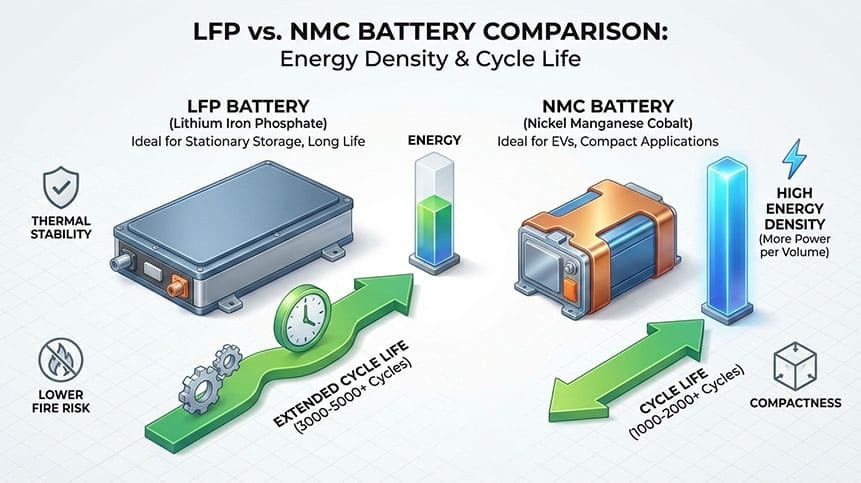
Every battery contains two technologies. The first is the electrochemistry, meaning the materials inside the cell that store and release energy. The main chemistries today are LFP (lithium iron phosphate, cheaper and safer but stores less energy per kilogram), NMC (nickel manganese cobalt, more energy-dense but more expensive), sodium-ion (uses cheap, abundant sodium instead of lithium, still early), and solid-state (replaces the liquid inside the cell with a solid, promising better performance but nobody has figured out how to mass-produce it yet). This is what academic journals publish, what venture capital funds, and what journalists write about.
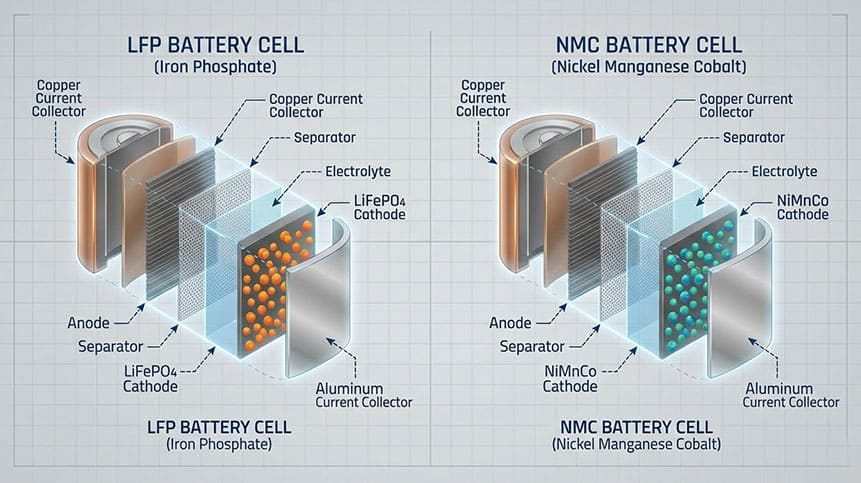
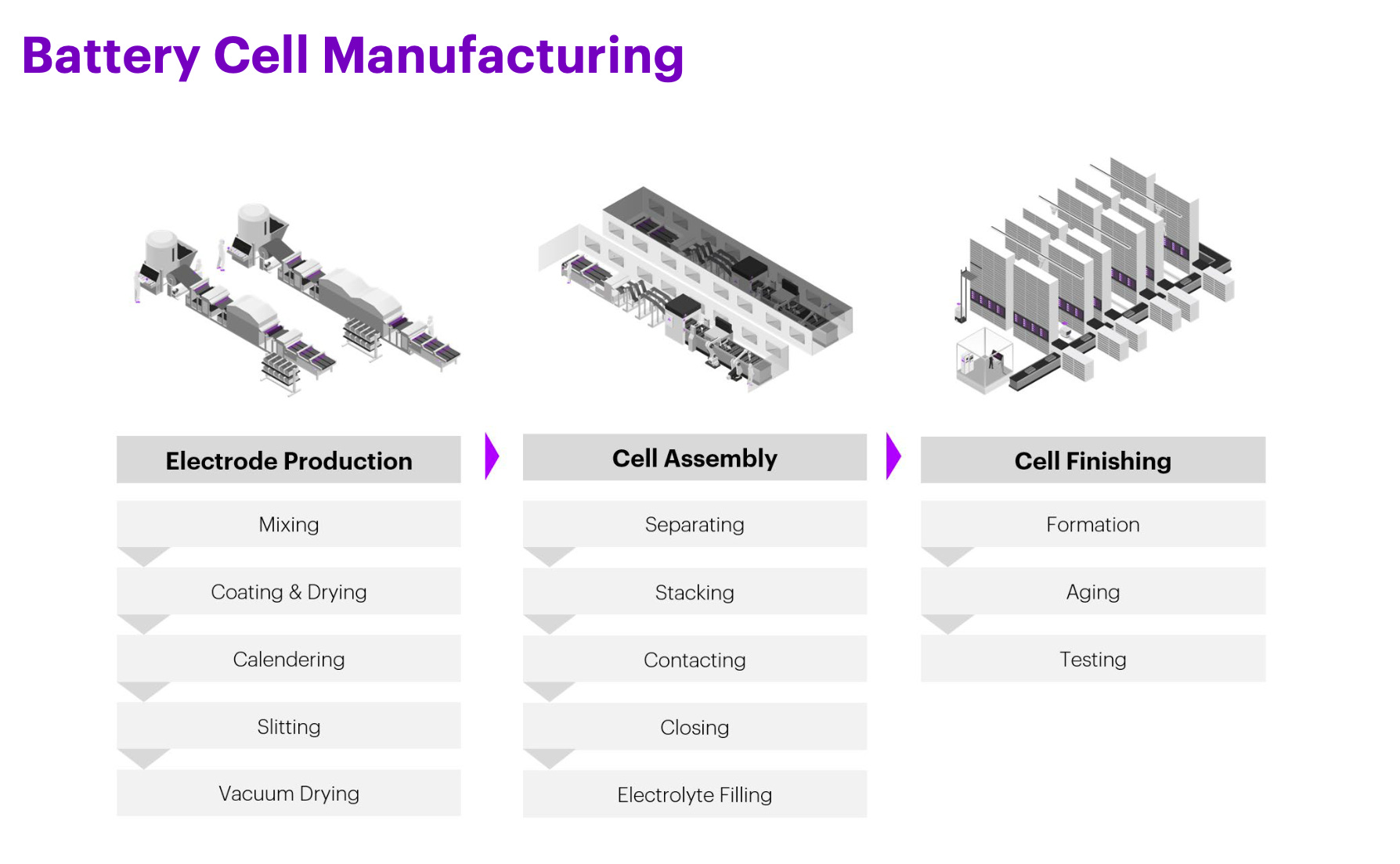
The second technology is the manufacturing process, and it gets almost no attention. Making a lithium-ion cell requires mixing raw cathode and anode powders into a slurry, coating that slurry onto thin metal foil at high speed, drying it, compressing it under precise pressure (a step called calendering), slitting the coated sheets to size, stacking or winding them into a cell, filling the cell with liquid electrolyte, sealing it, running controlled charge-discharge cycles to activate the chemistry (formation), aging the cell, testing it, grading it by performance, and finally integrating it into a battery pack. Every one of those steps has hundreds of interacting variables: humidity, coating speed, slurry viscosity, drying temperature, compression pressure, electrolyte fill volume. Change one variable at the coating stage and defects can appear three steps later during formation.
A 2025 paper in Nature Communications makes this concrete. Even a defect rate of 0.1%, which sounds tiny, is far too high. Each cell contains roughly 100 electrode sheets, and each battery pack contains about 30 cells, so one pack has 3,000 sheets. At a failure rate of 1 in 10,000, a defective sheet shows up in every fourth pack. That means over 25% of finished packs contain a flaw. At production volumes of millions of packs per year, that translates into hundreds of millions of dollars in waste.
The yield gap
The single most important number in battery manufacturing is yield: the percentage of cells that come off the production line and are actually good enough to sell. The IEA’s 2026 Global EV Outlook says it directly: competing in today’s battery market requires production yields above 90%. When a new producer starts operations, the share of output that is unsellable is often far higher than needed for profitability.
Data from Fraunhofer and RWTH Aachen shows just how bad it gets. During early ramp-up, scrap rates reach 70 to 80%, meaning you throw away most of what you make. Scrap rates of 15 to 30% are common for years after that. It often takes more than five years from the start of operations to reach full output levels. Equipment makers confirm that startups typically begin around 40% yield, while established producers sit at 90% or above. Each single percentage point of yield improvement in a gigafactory is worth tens of millions of dollars per year, because every defective cell that becomes a sellable cell is pure margin.

Now compare that to CATL, the world’s largest battery producer. In 2025, CATL ran at 96.9% capacity utilisation, up from 76.3% in 2024. They shipped 661 GWh of batteries, a 39% increase year-over-year. Revenue hit RMB 423.7 billion (about $58.4 billion). Gross margin was 26.27% and expanding. Operating cash flow rose 37%. They ended the year with 772 GWh of operating capacity and another 321 GWh under construction. By Q1 2026, CATL had crossed 50% domestic EV battery market share. These are the numbers of a company that has been optimising its production processes for over a decade, compounding small improvements every year.
Knowledge you can’t write down
Some knowledge is easy to transfer. A patent says: use this cathode formulation at this ratio. A paper gives you the electrolyte composition. You can copy that. But the knowledge that actually drives manufacturing yield is different. Most of it is tacit, meaning it exists in the heads of engineers and operators, not in documents.
The kind of knowledge that matters: at this specific humidity and coating speed, edge defects start appearing on the electrode sheets. This particular supplier’s cathode powder behaves differently at industrial scale than it did in the lab sample. Increasing line speed by 4% causes delamination defects two process steps downstream. The coating machine technically runs at 120 meters per minute but yields collapse above 95. This equipment layout makes roll changes 40% faster, which means less downtime and more output per shift.
You don’t learn any of this from a textbook. You learn it by running production lines for years, diagnosing failures at 2 AM, and slowly building up a catalogue of what works and what doesn’t. A study of China’s battery manufacturing clusters describes this as “learning-by-producing.” Practical knowledge from production gets fed back into components, equipment, and pack assembly. Specialist firms like Kedali (which makes precision structural parts for cells) and Yinghe Technology (which builds integrated production line equipment) became what the study calls “hidden champions” in their segments because of this tight loop between making batteries and improving the machines that make batteries.
Fraunhofer’s ramp-up research gets into the specifics of how this works. When a new production line starts, electrode coating begins at low speed. You gradually increase it. The goal is a coating film of uniform composition and thickness, with defined residual moisture content, no defects, and top-and-bottom coatings aligned as closely as possible. Factories build error catalogs that document every possible defect type, what caused it, how critical it is for downstream processing, and what it does to the final cell’s performance. That is not chemistry research. That is institutional memory, built one production shift at a time.
CATL has pushed this further by deploying AI and industrial IoT across its factories, which delivered a 17% increase in line speed and a 14% reduction in yield loss. Their Ningde plant has been designated a World Economic Forum Lighthouse factory, a recognition given to factories that demonstrate advanced manufacturing at scale.
Overcapacity as accidental education
By 2024, global battery manufacturing capacity had reached over 3 terawatt-hours, with about 85% of it in China. That was roughly three times actual demand for EVs and energy storage. By 2025, nameplate capacity crossed 4 TWh globally, and China still held above 80%.
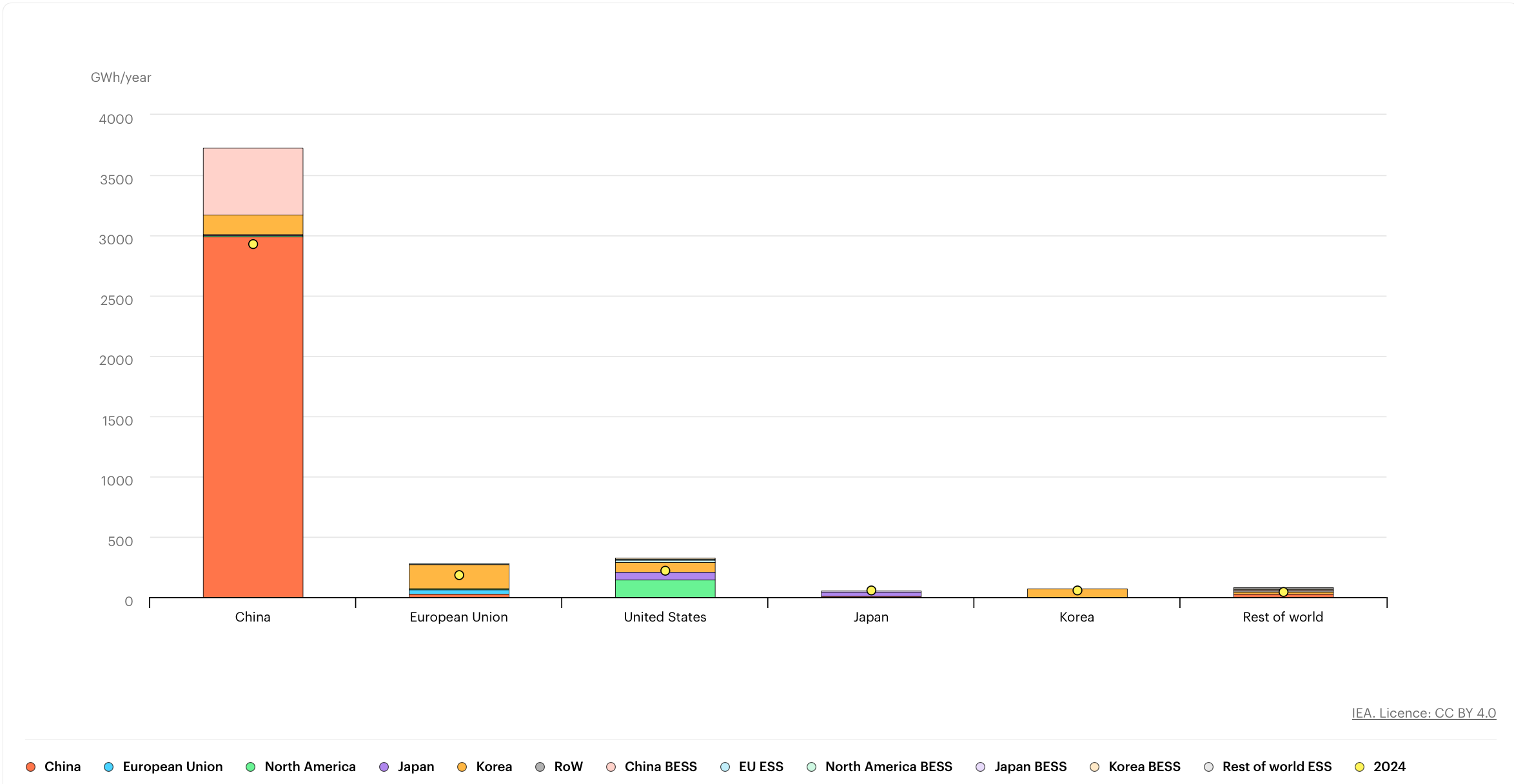
The standard read on this is terrible capital allocation. Factories sitting idle. Margins destroyed. Companies dying. All correct. But incomplete.
There’s no evidence Beijing deliberately engineered this overcapacity for learning purposes. That narrative is too neat. The stronger argument is that overcapacity produced an unintended knowledge accumulation system. When 50 battery companies compete inside the same country, buying from the same equipment suppliers, poaching each other’s engineers, all racing to hit 90%+ yield before running out of cash, something happens at the ecosystem level. One company optimises electrode thickness. Another improves formation protocols. Another automates optical inspection with machine vision. Another redesigns the pack to eliminate modules entirely. Another figures out how to make coating equipment 30% cheaper. Many of these companies fail. But their engineers get hired by the survivors. Their equipment suppliers keep operating and improving. The knowledge doesn’t leave the system. It concentrates.
Over 70% of all EV batteries ever manufactured were produced in China, according to the IEA. CATL and BYD scaled up faster and more efficiently than competitors and achieved higher manufacturing yields.
China’s battery industry had dozens of cell makers in 2020. By Q1 2026, CATL alone held over 50% of domestic EV battery installations and BYD had 17.5%. The top two control two-thirds of the market. Smaller players like SVOLT, Farasis, and dozens of others got squeezed or went bankrupt. But their engineers got hired by the winners. Their equipment suppliers kept operating. Their process knowledge didn’t disappear. It moved to the surviving companies.
CATL’s profitability reflects this compounding. The IEA reports operating margins of 10-15% each year from 2020 to 2024. In 2025, gross margin hit 26.27%, net profit reached RMB 72.2 billion (about $10 billion), and operating cash flow rose 37%. Comparative analysis shows LG Energy Solution and Samsung SDI running significantly lower utilisation and tighter margins. CATL achieved the highest capacity utilisation among all major global producers at roughly 90% through mid-2025, rising to 96.9% by year-end.
The equipment loop
There’s a second compounding effect. When a country builds thousands of battery factories, it also creates a massive market for battery manufacturing equipment. That market attracts specialist equipment companies, who compete with each other and make their machines faster, cheaper, and more precise. Which makes the next factory cheaper to build. Which means more factories get built. Which makes the equipment market even bigger.
Wuxi Lead Intelligent Equipment, founded in 1999, is the world’s largest supplier of lithium-ion battery manufacturing equipment. Over 10,000 employees. Their equipment covers electrode production, cell assembly, and formation lines. In August 2025, when Wuxi Lead announced they expected intensive capacity expansion among key clients, CATL’s stock hit a three-year high just from the signal. That’s how tightly coupled these two industries are.
Shenzhen Yinghe Technology builds integrated whole-line solutions covering front-end electrode equipment, middle-stage cell assembly, and rear-end cell finishing. In December 2024, they landed a turnkey order for two high-speed 4680 cylindrical lines going into a North American gigafactory. Chinese equipment, installed in an American factory. So even when a Western company builds its own gigafactory, a significant part of its capital expenditure flows back to Chinese equipment makers.
These companies, together with HangKe Technology, Putailai, and Colibri Technologies, held roughly 60% of China’s battery equipment revenue in 2024. The Chinese battery equipment market was estimated at $10.52 billion in 2026.
Inventing, patenting, and manufacturing are different things
There’s a common claim that China just copies Western battery technology. The actual history is more complicated.
Japan commercialised lithium-ion batteries when Sony put them in consumer electronics in 1991. American and European researchers made fundamental contributions to cathode and anode chemistry. Korean firms like LG, Samsung, and SK became world-class cell producers and built large overseas factories. China entered the industry later.
But the geography of innovation shifted. By the late 2010s, Chinese companies were filing more battery production patents than anyone. China now has enormous patent strength in LFP, sodium-ion, and manufacturing processes, while leadership in some high-energy chemistries like solid-state and high-nickel NMC remains distributed across China, the US, Europe, and Korea.
The important distinction is that inventing a chemistry, patenting it, turning it into a commercial product, and mass-producing that product at low cost are four separate capabilities. Most battery commentary treats them as one. They are not the same thing. Japan invented. Korea commercialised. China mass-produced. And mass production at scale, maintained long enough, generates its own form of innovation: process innovation. It doesn’t get published in academic journals, but it’s what actually drives $/kWh down.
Chinese battery production in 2025 was 1,756 GWh. For context, total global production was about 1 TWh just one year earlier. At that kind of volume, even small process improvements multiply into enormous cost advantages. A 1% yield improvement across 1,756 GWh saves billions of yuan in scrap and rework annually, and those improvements happen continuously, on every line, at every factory.
LFP: proof it works
LFP, or lithium iron phosphate, is the clearest proof that manufacturing and engineering innovation can beat raw chemistry. LFP wasn’t China’s invention, and at the cell level it has a real disadvantage: it stores less energy per kilogram than nickel-rich NMC chemistries. For years the Western consensus was that LFP was fine for cheap stationary storage but couldn’t power serious electric vehicles because the cars would need bigger, heavier packs to get the same range.
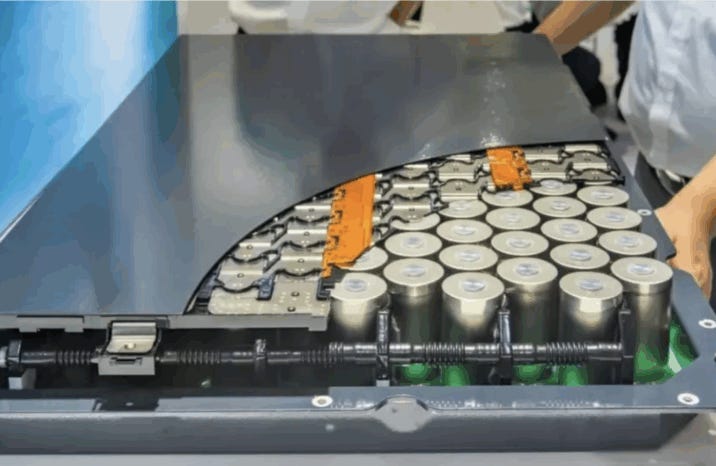
Chinese companies didn’t try to fix the chemistry. They fixed everything around it. BYD’s Blade Battery, launched in 2020, uses elongated flat prismatic cells (960mm long, 90mm high, 13.5mm thick) arranged directly into the pack with no intermediate modules. This cell-to-pack architecture eliminates the dead weight and dead space of module enclosures, so more of the pack volume is actually storing energy. CATL’s Qilin battery (CTP 3.0), in mass production since 2023, achieves 72% volume utilisation, the world’s highest, by placing liquid cooling directly between adjacent cells. BYD’s second-generation Blade goes further with cell-to-body technology, where the pack itself becomes a structural component of the vehicle chassis.
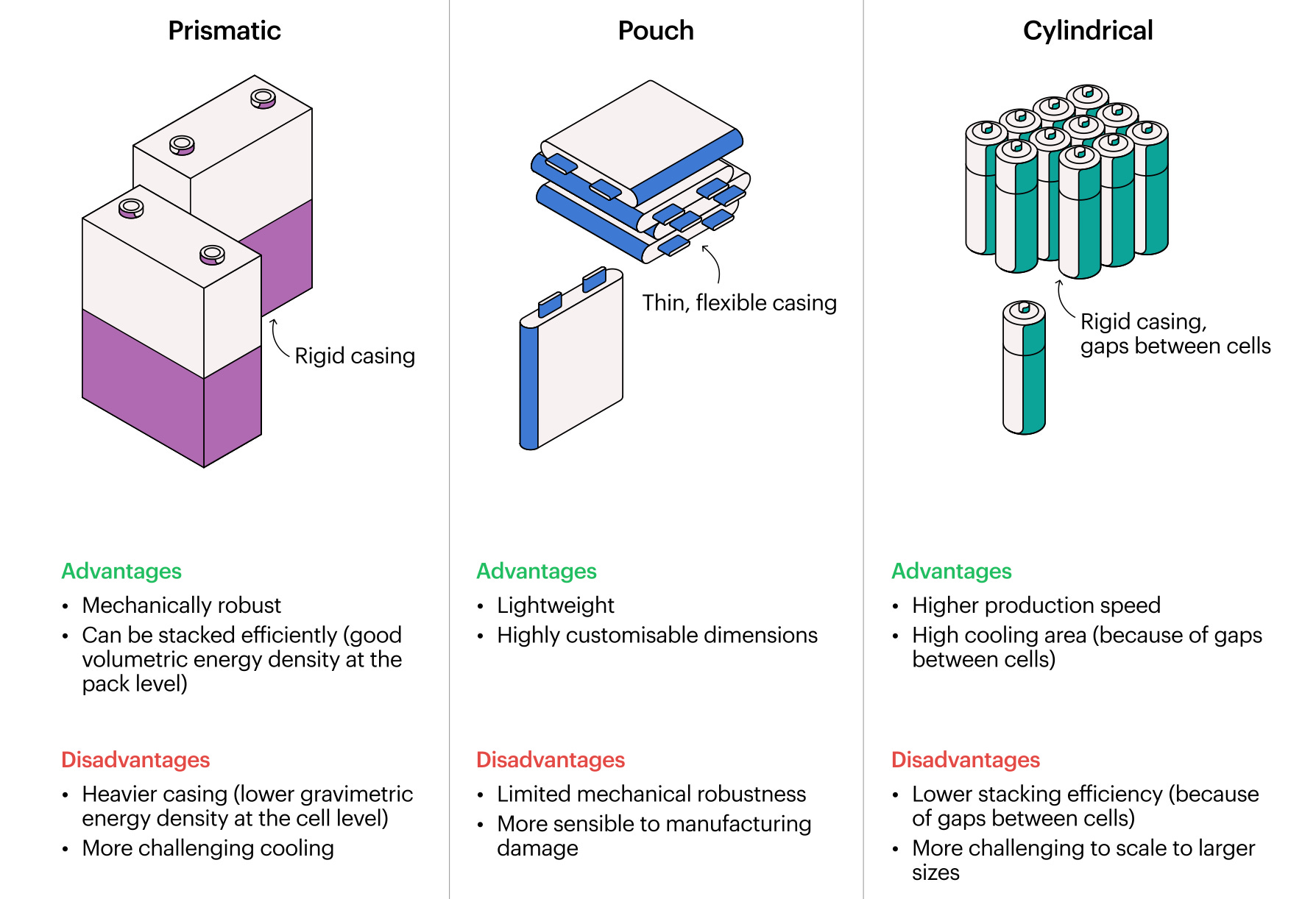
The result: instead of making a better chemical, Chinese companies took a cheaper, safer, “inferior” chemistry and wrapped it in better manufacturing, pack engineering, and vehicle integration. LFP packs averaged $81/kWh in 2025 while NMC packs averaged $128/kWh, a 37% price gap. The lowest observed Chinese LFP cells hit $36/kWh for cells and $50/kWh for packs in stationary storage. LFP now covers nearly half the global EV market, and nearly all LFP batteries sold in Europe and the US are produced in China. BYD overtook Tesla in 2025 as the world’s largest seller of battery EVs, delivering about 2.26 million BEVs.
Prices fell while inputs got more expensive
Battery metal prices went up in 2025. Lithium carbonate rebounded over 90% from its June trough. Cobalt got hit with new DRC export quotas. By input cost logic, batteries should have gotten more expensive. They got cheaper. BloombergNEF attributed the continued decline to overcapacity, competition, LFP adoption, long-term supply contracts, hedging, and manufacturing improvements. Not cheaper raw materials.
You can buy lithium on the open market. You can finance a factory with project debt. You can sometimes license a patent. You cannot purchase a 14% reduction in yield loss. That comes from running production lines for years and systematically learning from every failure.
Europe spent $14 billion and learned the hard way
Northvolt was Europe’s flagship battery project. Founded by two ex-Tesla supply chain executives. Volkswagen owned 21% and Goldman Sachs 19%. Over $14 billion in total capital raised, including a $5 billion green loan in 2024. Beautiful factory in Skellefteå, Sweden. World-class engineers.
Reuters obtained internal production data showing that during one week in November 2024, Northvolt’s flagship factory produced about 26,000 shippable cells against an informal target of roughly 100,000 per week. Equipment problems. Inexperienced staff. Quality issues everywhere. BMW cancelled a $2 billion contract in June 2024 because Northvolt couldn’t deliver on time. The company was burning about $100 million per month.
Chapter 11 in the US in November 2024. Bankruptcy in Sweden on March 12, 2025. Largest bankruptcy in modern Swedish industrial history. US startup Lyten bought the Swedish assets in February 2026 for about €180 million. For facilities that cost billions to build.
Northvolt was not alone. Norway’s Morrow Batteries went bankrupt on May 6, 2026. They had actually started series production in January 2026 and completed first customer deliveries in April. Over NOK 5.1 billion in cumulative funding consumed. Dead anyway. After Northvolt and Freyr Battery, Morrow was the third Scandinavian battery company to collapse in 18 months.
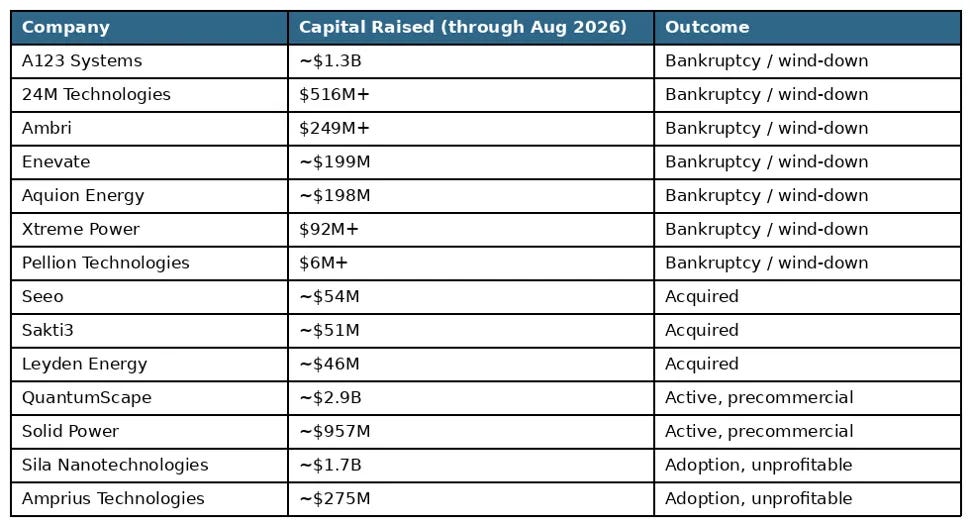
The IEA explains why this keeps happening: even experienced firms face slower production ramp-up in regions with less mature battery industries because of the lower availability of specialised workforce and equipment manufacturers to rapidly troubleshoot and resolve production challenges. You can build a factory. You cannot build an ecosystem with money alone. Buying the machines for a gigafactory and knowing how to run them are two completely different things.
The next chemistry question
Western and Japanese companies keep announcing solid-state battery breakthroughs, and some of them are real. But suppose someone cracks a working solid-state cell in a lab tomorrow. The harder question follows: who manufactures the first billion of them at competitive cost?
China’s equipment makers, trained workforce, and supplier networks could transfer to the new chemistry. Or they might not. Solid-state cells would need different manufacturing steps because there’s no liquid electrolyte to fill. Instead you have new problems: getting good physical contact between a solid electrolyte and an electrode, managing the mechanical stress from lithium metal expanding and contracting during charge cycles, and doing all of this at scale without destroying yield. These are manufacturing problems, not chemistry problems, and they’re problems that current Chinese production lines haven’t had to solve.
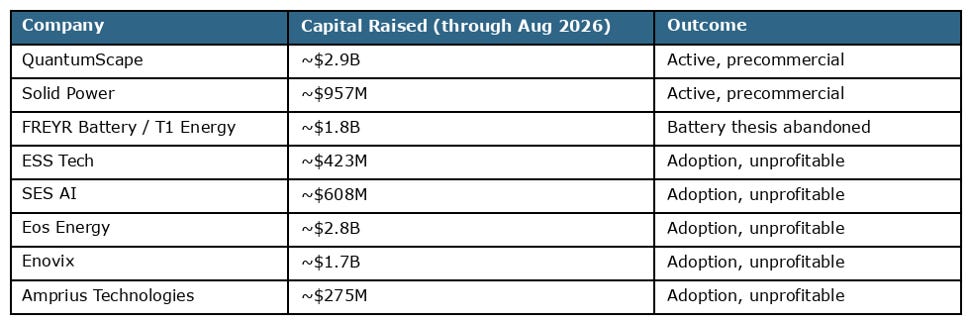
Toyota has been working on solid-state for over a decade and holds a large patent portfolio. QuantumScape in the US has been at it since 2010. Samsung SDI has a solid-state pilot line. If any of them crack the manufacturing puzzle, there’d be a window where China’s accumulated liquid-electrolyte knowledge doesn’t help. But that window might close fast, because once a manufacturing process is defined, China’s industrial system is built to learn it and scale it quickly.
Meanwhile, CATL announced a second-generation sodium-ion battery in late 2024 with 200 Wh/kg energy density. BYD is scaling sodium-ion too. Western sodium ventures collapsed as LFP kept getting cheaper: Natron Energy in the US shut down and Northvolt’s sodium-ion program died with the company. Factorial Energy, a US solid-state startup, reports 85% yield at pilot scale, up from 10% at the start. That 10%-to-85% journey took years of engineering, and 85% pilot is still below the 90%+ the IEA says you need for mass production.
Does China’s manufacturing advantage survive a fundamental change in battery architecture? Nobody knows. That’s an honest answer.
The paradox
China’s system produced fantastically cheap batteries, the fastest price declines in industrial history, and companies like CATL ($58.4 billion revenue, $10 billion net profit, 24 factories, 6 R&D centres globally) and BYD that are genuine manufacturing powerhouses.
The same system also produced excess capacity, crushed margins, dead companies, duplicated investment, trade friction, and financial risk. Capacity utilisation across the broader Chinese battery sector was below 50% until recently. Plenty of smaller Chinese battery companies went under too. Chinese production grew 60% in a single year, from 1,097 GWh in 2024 to 1,756 GWh in 2025. That kind of supply growth destroys pricing power for everyone except the most efficient.
The EU has responded with anti-subsidy investigations and tariff threats. The US already has tariffs in place. These are rational responses from governments trying to protect domestic industries. But tariffs protect local producers from price competition. They don’t transfer manufacturing knowledge. They don’t teach producers how to hit 90%+ yield.
The mechanism that creates technological learning also creates enormous waste. Most commentary picks one side: China is brilliant, or China is wasteful. Both are true simultaneously. What looks like waste at the company level may be accumulated knowledge at the ecosystem level.
This is not about batteries
If this thesis holds, the story is bigger than batteries. It’s about how countries acquire industrial capability now. The same pattern applies to solar panels (already happened), drones (happening), robotics (starting), and maybe AI hardware (could happen).
The conventional innovation model runs: science, then invention, then patent, then company, then factory. The Chinese battery story suggests another pathway: factory, then volume, then failure, then learning, then supplier ecosystem, then engineering improvement, then innovation. One starts with discovery and works toward production. The other starts with production and works toward mastery. The second is harder to copy because it requires years of accumulated mistakes, and you cannot skip the mistakes because they contain the knowledge.
Companies that look perfect on paper, great IP, great team, great cap table, hit manufacturing scale and everything falls apart. The ones that survive are the ones that have been making things, badly, for long enough to get good at it. No shortcut.
The race for the next battery probably won’t be won by whoever discovers it first. It’ll be won by whoever can afford to make the most mistakes while learning how to manufacture it.
That rejected cell in Ningde cost money. But the data it generated made the next million cells cheaper. Multiply that across a decade of production. That’s the advantage.
Sources:
BloombergNEF, “New Record Lows for Battery Prices” (Dec 2025)
IEA, “The battery industry has entered a new phase” (March 2025)
Nature Communications, “Challenges for battery production at scale” (2025)
Fraunhofer/RWTH Aachen, “Mastering Ramp-up of Battery Production” (2024)
Electrive, “Lyten completes Northvolt acquisition” (Feb 2026)