


Morning guys, happy Saturday.
There is a habit I’ve noticed in business writing where once something works, we immediately invent a clean explanation for why it worked. A startup gets its first ten customers and suddenly it has a “sales motion.” A product grows and we decide which feature caused it. A new technology changes hiring and the story becomes that AI is taking jobs. The explanation is usually much neater than the system underneath it.
That matters because the explanation determines what happens next. If you misunderstand why customers are buying, you hire around the wrong sales process. If you misunderstand why a product is sticky, you can optimize away the thing people actually liked. If you misunderstand how a labor market is adjusting, you solve for layoffs while the real change is happening at the hiring door.
A few things I’ve been reading recently are good reminders that outcomes and mechanisms are not the same thing. Getting the result once is useful. Understanding what produced it is what lets you do it again.
1. Founder-led sales is supposed to stop working
In 2023, Warmly went from zero to more than 100 paying customers. The more interesting part of Maximus Greenwald’s breakdown is how deliberately the founder removed himself from the process as the year went on. The first ten customers were founder-led, customers 10 to 30 added a sales leader, the next phase put sellers in front while the founder stayed involved, and by the time Warmly crossed 100 customers the goal was for the founder to stop closing altogether.
At first that sounds like a fairly normal sales hiring story, but I think the sequencing matters more than the hires. In Q1, Warmly was not really trying to scale sales. It was trying to understand whether anybody would buy, what they objected to, how the product should be described and which parts of the pitch survived contact with an actual customer. The founder was doing sales because the company still needed the information more than it needed efficiency.
This is why hiring a polished sales organization too early can be weirdly counterproductive. You are asking someone to repeat a playbook that does not exist yet, so the new hire either invents one themselves or executes whatever playbook worked at their last company. Ravi Parikh made a similar point when talking about building the early sales team at Heap: the first reps had to be part salesperson, part sales engineer and part product marketer because specialization creates overhead before there is enough repeatable work to specialize.
There is another thing happening in those first few deals that gets lost once people start drawing funnels. Early customers are not only evaluating the product. They are evaluating whether this tiny company will still exist next year and whether the founder will pick up the phone if something breaks. Shruti Kapoor described this as the early startup’s “trust deficit”, which is why founder-led sales can outperform a theoretically better salesperson when the company has almost no proof yet.
The handoff should therefore happen gradually because what you are transferring is not a list of scripts. You are turning all the strange little things the founder has learned into something another person can reproduce: who gets excited, which objection actually matters, which demo sequence works, when to push, when to stop talking, and which customers are politely saying no even though they sound interested.
Warmly’s Q4 is probably the most important part of the whole story because the GTM strategy barely changed. That was the point. Once the same process could be run by sellers, managed by a sales leader and produce roughly understandable inputs and outputs without the founder rescuing every deal, sales had started becoming a system rather than founder skill.
The first ten customers prove that you can sell something. The next hundred start proving that the company can.
2. Ozempic works. The explanation is getting stranger.
GLP-1 drugs are a good example of something becoming enormously useful before scientists have completely mapped the mechanism behind the result. One common explanation for drugs such as semaglutide has been that they reduce appetite partly by suppressing AgRP neurons, a set of neurons associated with hunger. But new research from Yale found something unexpected in mice: during chronic semaglutide treatment, those hunger-related neurons became more active, not less.
The researchers then removed or silenced those neurons and found that the animals could no longer sustain the same weight-loss effect. The proposed mechanism is more complicated than “drug turns hunger off.” The calorie deficit created by treatment appears to recruit these neurons as part of a broader metabolic adaptation that helps sustain fat loss. This was a mouse study, so it is not evidence that the same mechanism works identically in people, but it does complicate a very intuitive story about why these drugs work.
I like this example because companies do the same thing with products all the time. Something works, so we attach the easiest explanation to the visible behavior. People use the social feature, therefore they must want more social features. Customers stay on the paid plan, therefore the premium dashboard must be sticky. Users spend hours in the app, therefore engagement is obviously the thing to maximize.
Then somebody “improves” the product around that explanation and accidentally damages the mechanism that was producing the result.
This is why good product research can feel frustratingly slow. Analytics will tell you what people touched. Interviews will tell you what people remember touching. Neither automatically tells you which part created the value. Sometimes the useful variable is something nobody thought to measure because everybody already agreed on a cleaner explanation.
The commercial success of GLP-1 drugs came before a complete understanding of their biology. Products can work the same way. The dangerous moment is when success makes us overconfident that we understand why.
3. “Undruggable” often means “undruggable with the tools we have right now”
In August, the FDA approved Rasonque, or daraxonrasib, for certain adults with metastatic pancreatic adenocarcinoma. The drug targets multiple forms of RAS, a family of proteins that drives tumor growth in most pancreatic adenocarcinomas and has spent decades being one of oncology’s notoriously difficult targets.
The Phase 3 results are pretty remarkable. In the trial population, median overall survival was 13.2 months with daraxonrasib versus 6.7 months with standard chemotherapy, with a 60% reduction in the risk of death. This is not “cancer solved,” obviously, and the approval is for a specific population with metastatic pancreatic cancer, but it is a meaningful advance against a target scientists spent a very long time struggling to reach.
The part I keep coming back to is the word undruggable. It sounds like a property of the target itself, but often it is really a description of the available toolset at a particular moment. The biology did not suddenly become easier. Chemistry, structural understanding, screening techniques and the surrounding research stack improved enough that a problem which looked unreasonable in one decade became tractable in another.
That distinction matters outside science because markets accumulate abandoned problems too. There are ideas somebody tried in 2012 when mobile hardware was worse, payments were painful, models were dumb, cloud infrastructure was expensive or the necessary distribution channel did not exist yet. The startup failed, and over time “that company failed” quietly turns into “that idea does not work.”
Those are very different statements.
The interesting opportunities are sometimes hiding inside old failures where the constraint has since disappeared. A product requiring impossible computer vision ten years ago might be trivial now. A service that needed a call center might suddenly work with agents. A logistics idea that collapsed under delivery costs can change completely if autonomous delivery becomes cheap enough.
You still need to be careful because plenty of bad ideas remain bad when technology improves. But “people already tried this” is much less useful than asking exactly why they failed and whether that reason is still true.
Sometimes the market is wrong. More often, the market was right at the time.
4. AI may be removing the first rung before it removes the whole ladder
The cleanest AI employment story would be mass layoffs. It is also not what the best data currently shows. Stanford researchers using payroll records from millions of U.S. workers found no evidence of widespread economy-wide displacement, but they did find a sharp divergence among younger workers in occupations highly exposed to generative AI.
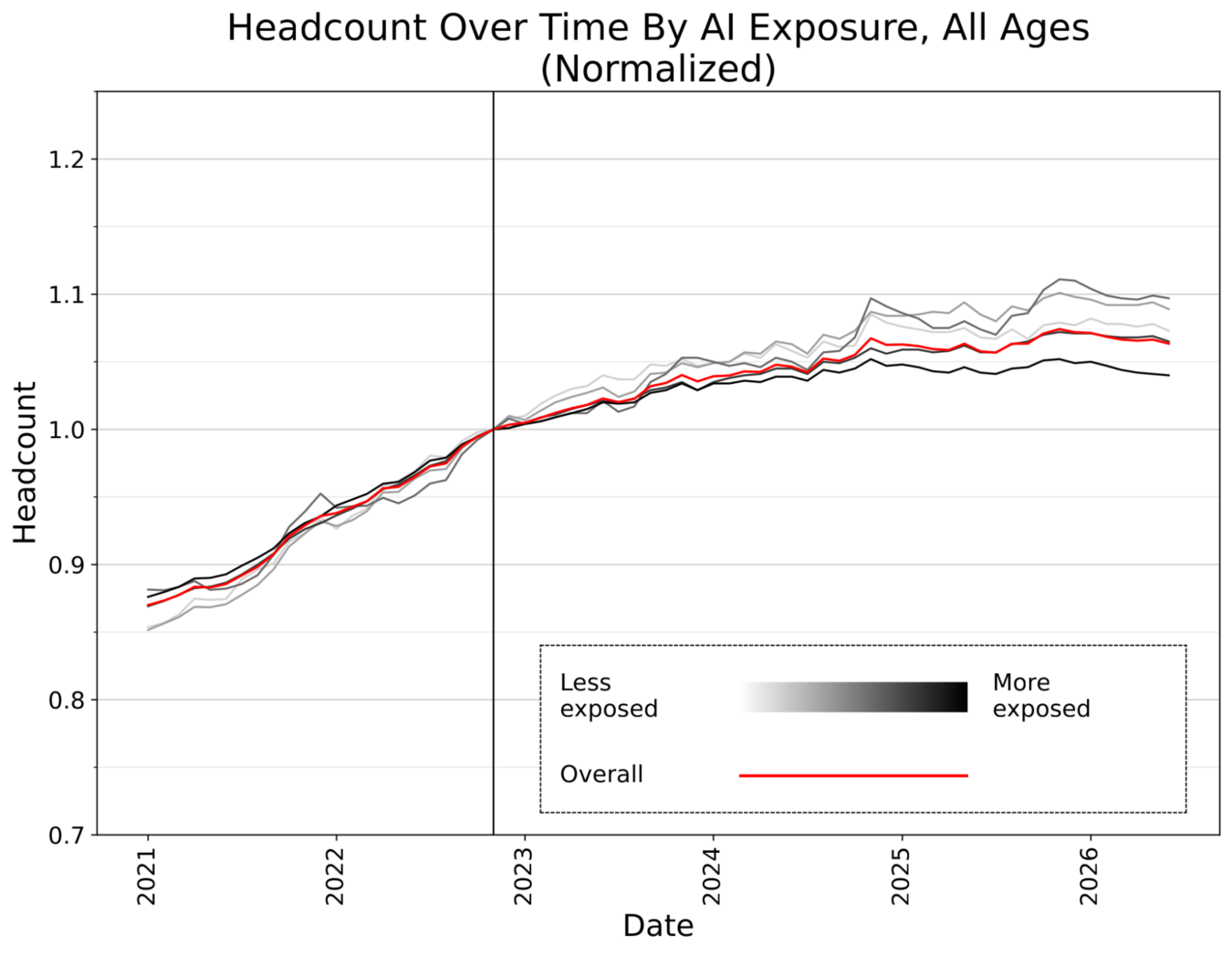
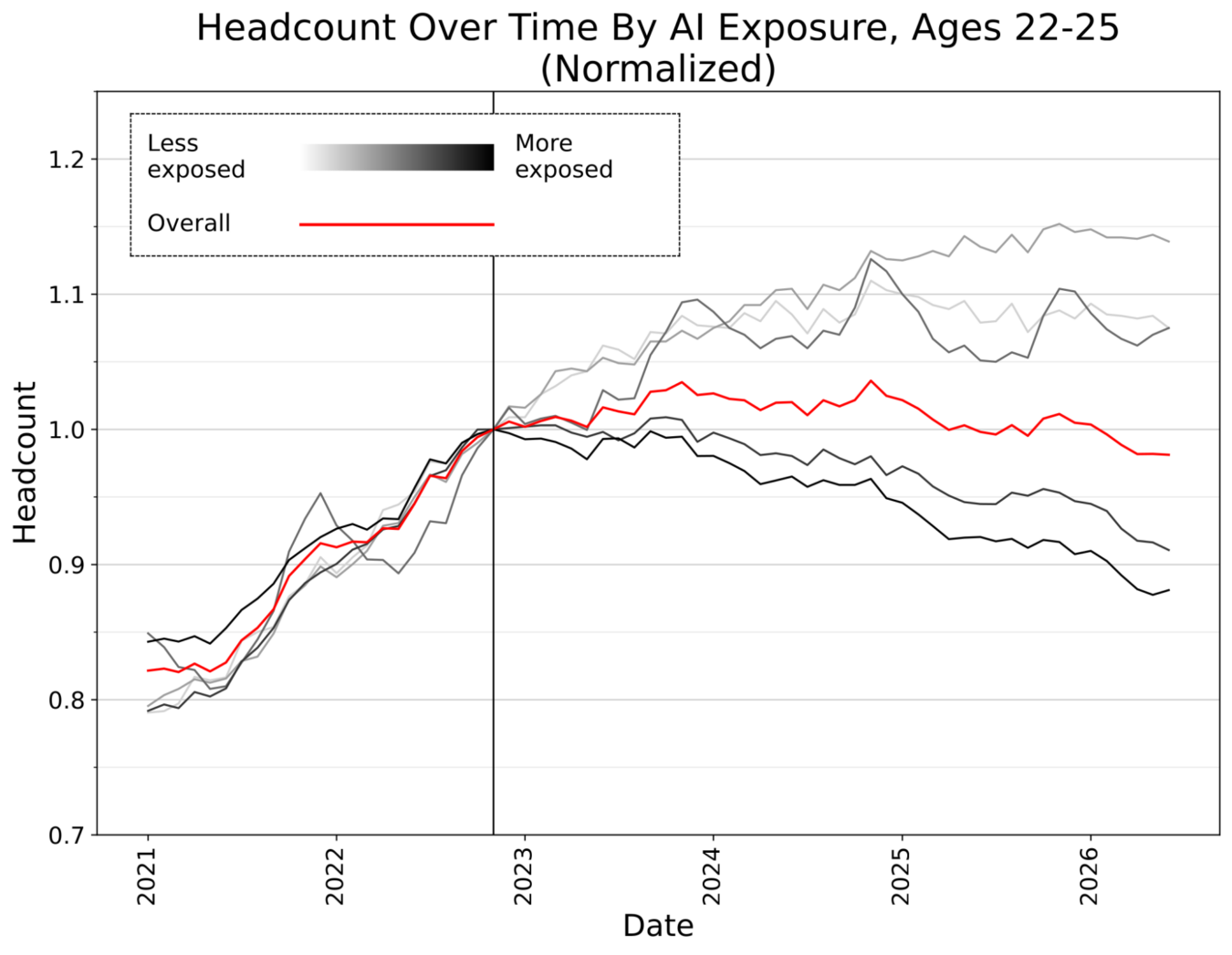
Employment among 22 to 25-year-olds in those occupations was about 19% below where it would have been if it had kept pace with similarly aged workers in less AI-exposed jobs. More importantly, Stanford found that the adjustment appears to be happening mainly through reduced hiring rather than increased separations. Companies are not necessarily replacing a room full of junior employees with Claude. They may simply be deciding they need fewer juniors the next time they open a role.
That is a much quieter change, which is probably why it matters. Layoffs make headlines and appear in official announcements. A role that never gets created leaves almost no trace. Ten companies deciding not to hire their next junior analyst can change a career market without any CEO ever saying “AI replaced these jobs.”
There is a second-order problem here that I think companies are going to run into later. Senior workers do not appear from nowhere. Most become senior by spending years doing the repetitive, slightly boring work that companies are now particularly tempted to automate. If you remove enough of that apprenticeship layer, you can save money today while accidentally shrinking the pool of experienced people you need five years from now.
This does not mean companies should preserve pointless work as a training program. It does mean the old path where a junior employee learned by producing the first draft, doing the basic analysis or writing the simple code may need a replacement. The interesting question is not whether a 23-year-old can beat an AI at the tasks we used to give new hires. They probably should not have to.
The question is how someone becomes excellent when the work that used to make them excellent is increasingly done by software.
We have spent a lot of time asking what AI does to jobs. I suspect the stranger question will be what it does to careers.
5. Spotify built the audiobook habit before asking people to pay more for it
Spotify entered audiobooks in a fairly normal way at first, selling individual books. Then in 2023 it made a much more interesting move: Premium subscribers started getting 15 hours of audiobook listening each month from a large catalogue without needing to buy a book separately.
That removed a surprisingly important decision. Audible asks you to decide that you want an audiobook and then spend a credit or money on one. Spotify could put a book beside the music and podcasts inside an app millions of people already opened every day. The user did not need a new subscription, new app or new habit before trying the format.
Three years later, Spotify says audiobook listening hours are up 60% year over year, while Audiobooks+ has crossed one million paying subscribers and is on track for roughly $100 million in annualized recurring revenue. Audiobooks+ is the clever part of the sequence because Spotify did not begin by asking people to pay extra. It gave Premium users enough listening to create the behavior first, then sold additional hours to the subset who repeatedly hit the limit.
That reverses the normal subscription funnel. Usually a company asks someone to pay, then hopes they develop the habit that justifies the purchase. Spotify already had the habit, attached a new behavior to it for almost no additional effort from the user, watched who became unusually engaged, and only then introduced another paid layer.
There is a useful product principle hiding in there. Before asking how to convince somebody to adopt a new product, ask whether you can attach the behavior to something they already do. A budgeting feature inside the banking app somebody already checks, a research workflow inside the browser they already use, or an AI capability inside the tool where the work already happens has a very different adoption problem from another icon asking to earn a place on the home screen.
Distribution is usually discussed as how people discover a product. Spotify is a reminder that distribution can also determine whether the behavior happens at all.
Sometimes the product is not missing a better feature. It is missing a place in somebody’s existing day.
The common thread across all five stories is that the visible result can arrive well before the system underneath it becomes obvious. Warmly could sell before it had repeatable sales. Semaglutide could produce weight loss while scientists were still uncovering important pieces of the mechanism. RAS could look impossible until the surrounding tools changed. AI can alter employment through jobs that never open rather than people being fired. Spotify could create audiobook demand simply by moving books into a habit that already existed.
The result tells you that something happened. The mechanism tells you what to do next.
That second part is usually where the interesting work starts.

If you’ve been enjoying Token Economy, subscribe and share it with someone who might like it too. Each week, we look at what’s changing in AI, tech, startups, and business, why it matters, and where things might be heading next.