


Morning guys, happy Saturday.
There is a slightly annoying thing about finding product-market fit: eventually the thing that made you successful can start limiting what you are allowed to become.
You win because customers associate you with one problem. Then that association gets stronger. Sales gets easier, referrals get better and your brand becomes shorthand for the category. Great. Except now the market has a very specific idea of what you are, even if the product underneath has quietly become capable of much more.
The same thing happens with distribution. A company starts by using someone else’s channel, eventually owns enough demand that other companies want access to it, then discovers the channel might be more valuable than the thing it originally distributed. Netflix spent years being the content people subscribed to. Now it is at least considering becoming the place where people subscribe to everyone else.
I think the common thread is that the most valuable layer of a business keeps moving. Sometimes it starts in the product, moves into the data, then into distribution, brand or infrastructure. The difficult bit is noticing when your old advantage has become a constraint.

1. Netflix might be more valuable as a shelf than another thing on the shelf
Netflix has reportedly discussed bringing services such as Peacock and Fox One inside the Netflix app. There is no announced deal yet, and even the structure is unsettled. Netflix could potentially sell subscriptions to those services, surface their programming inside its interface, or do some variation of both. The Verge’s reporting on Netflix opening its app to rival streamers
It would not come completely out of nowhere. Netflix has already started experimenting with this idea in France, where it integrated TF1’s live channels and on-demand programming directly into Netflix. Co-CEO Greg Peters later described the early results as promising and said Netflix would consider similar arrangements when they benefit Netflix members and the partner.
What I find interesting is how different this ambition is from simply buying another catalogue. Another show or studio is valuable for as long as people want that content. Owning the place where people decide what to watch lets somebody else’s content create value for you too.
Ben Thompson has been thinking about this through the aggregation lens and recently argued that Netflix selling other streaming services could make strategic sense, even if it represents a shift from the company’s original ambitions. Ben Thompson on Netflix becoming a streaming aggregator
This is the strange end state of great distribution. Early on, you spend money desperately trying to acquire customers. Later, suppliers start paying to get in front of the customers you already acquired.
Amazon did this in commerce. Apple does it through the App Store. Google did it with search. The initial product attracts demand, but eventually the demand itself becomes something the company can sell.
Netflix historically understood this from the opposite side. It resisted being absorbed into other streaming bundles because it wanted the relationship with its own subscribers. The slightly funny outcome would be Netflix eventually becoming the aggregator it avoided becoming inventory for.
There is probably a useful question here even if you are nowhere near Netflix scale: if you have become unusually good at reaching one type of customer, is your own product still the only thing worth distributing through that relationship?
Sometimes the second business hiding inside the first one is distribution.
2. Going narrow works so well that it can become difficult to escape
Sara Du wrote a great retrospective on what happened at Alloy Automation after the company spent nearly three years becoming known for commerce infrastructure. Alloy’s original ambition had actually been much broader: integration infrastructure in general. Commerce became the wedge because there was obvious demand, particularly during the pandemic, and a tiny team could move quickly around a much more specific market. Sara Du on Alloy’s vertical GTM strategy
That part of verticalizing makes intuitive sense. “Integration infrastructure for everyone” is difficult to sell when you are tiny. “Integration infrastructure for commerce companies” tells marketing where to aim, sales who to call, partnerships who matters and product which problems deserve attention first.
Sara calls it something close to finding micro product-market fit. I like that framing because the point of the vertical is not necessarily to reduce the eventual ambition. It is to reduce the number of variables you need to solve at once.
Her framework for choosing the first vertical is also refreshingly practical. Look for pull, meaning a type of customer is already finding you. Look at timing, meaning the segment can become meaningful revenue quickly. Then look at your Rolodex, because knowing the important people and partners inside a small industry can be a much bigger advantage than it looks from outside.
The harder problem showed up later. Alloy’s customers increasingly wanted ERP, accounting and finance integrations. Companies outside commerce started approaching the team with problems Alloy could already solve. Sales found itself repeatedly explaining that, despite all the commerce messaging, the underlying product was much broader.
The wedge had worked so well that the brand became narrower than the product.
I think this is an underrated startup problem. Positioning does not just explain what you do. If it works, it changes what people notice you for. That is incredibly useful when you need focus, but every strong association also excludes other associations. Become “the commerce integration company” for long enough and even people who know you may stop thinking of you when a non-commerce integration problem appears.
So when has a vertical done its job? Sara’s experience suggests the answer probably is not “once we own X% of the market.” The better signal is when reality keeps pushing past the positioning. Customers ask for adjacent workflows. Referrals arrive from other industries. The product performs well somewhere the marketing says it should not. Sales starts spending time correcting the market’s idea of the company.
At that point, focus has started becoming friction.
The broader lesson is that early positioning should probably be allowed to be strategically incomplete. You are not writing your company’s biography. You are giving the market one simple reason to care about you now.
The mistake is forgetting that the sentence can change after it has done its job.
3. PostHog is building the company that might kill PostHog
PostHog recently asked a fairly uncomfortable question: if an AI-native team rebuilt our flagship product today, what would they build and what would they skip?
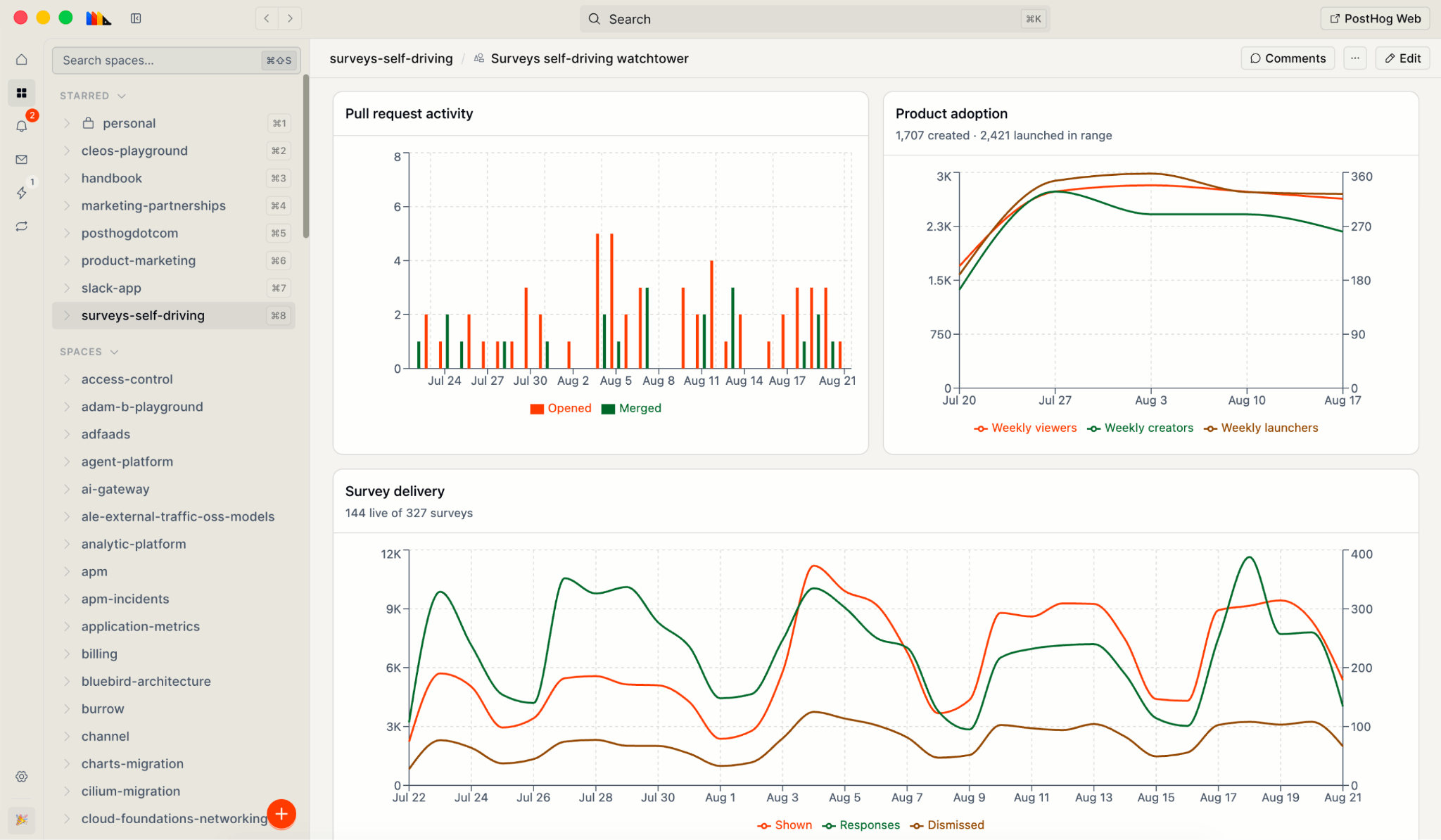
Instead of keeping that as an offsite exercise, they actually funded the answer. The work eventually became PostHog Desktop, which the company describes as an internal attempt to disrupt itself and find product-market fit again rather than assuming the current version lasts forever. PostHog’s case study on disrupting itself
I like this because companies usually talk about disruption in a very abstract way. Everybody agrees that AI might change the category. There are strategy decks about agents, model improvements and new interfaces. Then almost every engineer goes back to improving the product that already pays the bills.
That behavior is rational. Existing customers produce loud, specific feedback. Revenue tells you which requests look valuable. Your roadmap, team structure, analytics and sales process are all built around making the existing product a little better.
Unfortunately, that machinery can also be extremely good at making sure weird new ideas never survive.
PostHog’s premise is that product-market fit is not something a company permanently earns. A small AI-native team can arrive with none of your architectural baggage and ask which pieces of your product still need to exist at all.
One detail in the story is especially interesting. PostHog says a large customer had already combined its MCP capabilities with Claude and other tools to create something that looked suspiciously like a prototype of PostHog’s future. The customer was effectively showing them a different interface to the same underlying problem.
That feels like a useful signal to watch now. If customers start stitching together your API, an LLM and other tools to avoid interacting with your product in the way you intended, they may be designing your replacement for you.
The uncomfortable bit is that the replacement does not have to beat the old product on every feature. It just has to make the old way of doing the job feel unnecessary.
Product-market fit used to sound like a destination.
It increasingly feels like rent.
4. A laptop lid is interesting because nobody had priced the attention yet
There is now a marketplace called BrandMyLaptop where people sell advertising spots on the backs of their laptops. A creator lists areas of the lid, brands buy the spots, and the stickers stay there while that laptop travels through meetings, conferences, cafés, videos and whatever other places its owner works. Browse the BrandMyLaptop marketplace
The marketplace currently shows more than $13,000 worth of ad space sold, with individual placements ranging from tiny inexpensive stickers to much larger sponsorship packages. Some listings keep the sponsor on the laptop for as long as 24 months.
I have no idea whether laptop lids become a meaningful advertising category. Probably not. That is not really why I like the idea.
What is interesting is that it starts from attention rather than an existing ad format.
Most advertising begins with a container somebody already standardized. There is a feed, so we sell feed ads. There is a search result, so we sell sponsored results. There is a newsletter, so we sell a slot in the newsletter. Eventually everyone competes for the same inventory and the price climbs.
A laptop lid starts with a different question: where is my exact customer already looking that nobody has bothered to price?
A consultant sitting opposite executives all week may have a surprisingly useful rectangle of unused space on the back of a MacBook. A developer carrying a laptop through conferences has a different audience. Somebody whose laptop appears in every YouTube video has another.
The targeting is almost accidental. You do not need an ad platform to infer that someone staring at a consultant’s laptop during a client meeting probably overlaps with whatever industry that consultant works in.
That makes me think there are probably thousands of tiny pieces of unpriced attention hiding in ordinary workflows. A loading screen inside a niche piece of software. A shipping box that always gets opened by one profession. An internal report that gets forwarded around an industry. Something sitting on the table in every sales meeting.
None has enough scale to interest a giant ad network.
That might be exactly why some of them remain interesting.
The internet trained us to think distribution means finding the biggest possible pool of attention and targeting it more precisely.
Sometimes the better move is finding a tiny pool that nobody has priced yet.
5. Drone delivery gets interesting when the drone stops being the story
Uber and Zipline announced a partnership in August with a pretty aggressive target: one million drone deliveries per day by the end of 2029. Zipline deliveries will appear inside Uber Eats, starting in markets where Zipline already operates, while Uber is also making a strategic investment in the company. Uber and Zipline’s partnership announcement
Zipline says its system can deliver items in roughly five to ten minutes and that the initial Uber partnership will build from existing markets before expanding further across the US. Zipline’s explanation of the Uber rollout
DoorDash is approaching the same shift differently. In July, DoorDash Labs received FAA Part 135 air-carrier certification and launched DoorDash Air, allowing the company to commercially operate an in-house drone delivery service inside its existing marketplace. DoorDash’s announcement of DoorDash Air
The obvious story here is that drones are getting better. I think the more interesting story is that drones are becoming boring enough to turn into infrastructure.
Uber does not need to become the world’s best drone manufacturer. It already owns a giant demand surface where somebody taps a button and asks an object to appear. Zipline can become one method for moving that object. Another partner can handle sidewalk robots, another autonomous cars, another human couriers. The user can remain inside Uber while the logistics underneath become increasingly interchangeable.
That is basically how Uber has approached other autonomous technologies too: aggregate multiple operators behind the network rather than assuming Uber has to build every vehicle itself.
DoorDash is making a different bet. It has spent years working with drone partners and has now decided that enough of this layer matters strategically to justify building and certifying its own operation. DoorDash says the drones are being designed around local-commerce delivery and integrated directly into its existing marketplace infrastructure.
These sound like opposite strategies, but I think they are really different answers to the same question: where does our advantage actually live?
Uber is betting heavily on the demand layer. If the best drone comes from Zipline and the best robot comes from someone else, that is fine as long as the customer still opens Uber.
DoorDash seems to believe more of the delivery system itself can become part of the advantage. Merchant handoffs, routing, aircraft, landing constraints and the final interaction with the customer all affect the experience, so owning more of that system may eventually produce something a generic logistics partner cannot.
It reminds me of the Netflix question. Sometimes the valuable layer is the infrastructure. Sometimes it is the interface sitting above all the infrastructure. Sometimes it moves from one to the other as the market matures.
That is probably the larger thread here. Alloy used a vertical until the vertical started limiting it. PostHog is attacking the product that currently defines it. Netflix may turn competing services into inventory. Uber wants many delivery technologies underneath one demand layer, while DoorDash is pulling more of the delivery technology inside.
A good strategy creates an advantage.
A very good company notices when that same strategy has finished its job.

If you’ve been enjoying Token Economy, subscribe and share it with someone who might like it too. Each week, we look at what’s changing in AI, tech, startups, and business, why it matters, and where things might be heading next.